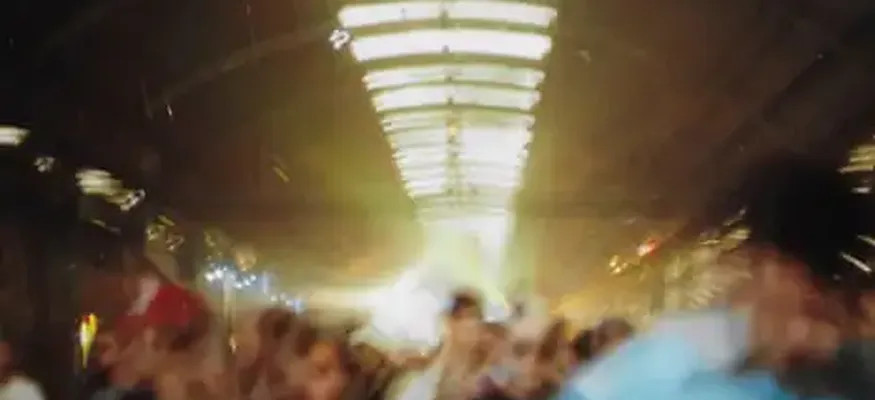
When Spiral Tribe fled England in 1992, they left behind an indelible mark on rave history. The itinerant sound system collective are best known for their involvement with Castlemorton Common festival, an unlicensed free party drawing more than 30,000 people and lasting nearly a week. After a drawn-out and notoriously expensive trial for public order offences, Spiral Tribe were acquitted of all charges. They decided to drive their repurposed military caravans out of the UK and never look back.
Their documented history often stops there. But little known is the fact that they then kicked off “the biggest illegal underground movement that Europe had ever seen”, says Spiral Tribe associate Sebastian Vaughan, AKA electronic musician 69db.
Many Spiral members, including Vaughan, settled throughout France after a warm response to the Spiral sound – a 160bpm sped-up version of hip-house with delayed kick drums, known as hardtek or tribe – and to the collective’s punk-rave aesthetic. Over the last three decades, their underground Teknival parties in France grew from about 1,000 attendees in 1993 to tens of thousands in 1995 and up to 100,000 people by the early 2000s, far exceeding the turnout at Castlemorton. French ravers, Vaughan says, “completely understood what the concept was, and they weren’t just following it, they were creating it themselves”. He attributes Spiral’s underground appeal to the country’s likeminded appetite for resistance.
But equally, “the French have always been very authoritarian and very brutal in their response to free parties”, says Mark Harrison, another Spiral Tribe founding member. He says he has witnessed the French riot police, known as Compagnies Républicaines de Sécurité (CRS), descend on dancefloors armed with stun grenades and rubber bullets in events from the mid-90s onwards.
In 2019, a police raid caused revellers at a Fête de la Musique concert in Nantes to fall into the Loire river, and 24-year-old Steve Maia Caniço was found drowned. Two years later, the CRS raided a Teknival rave in Rendon held in Caniço’s memory armed with tear gas and sting ball GM2L grenades. There were no attempts beforehand at dialogue or de-escalation. The violence resulted in a 22-year-old partygoer losing his hand. Another woman had her cheek pierced and teeth broken by a grenade fragment. Amnesty International France reported on the unnecessary use of force at the Rendon event as a human rights violation.
Now, the French parliament has formally enacted the Ripostpublic disorder law, targeting unlicensed music gatherings of more than 250 people. Free party organisers could face two years’ imprisonment, confiscation of their vehicles and sound equipment, and a fine of up to €30,000. Even attendees could face up to six months in jail and a €7,500 fine.
It feels similar to the crackdown Spiral Tribe faced in the wake of Castlemorton: two years later, the UK’s Criminal Justice and Public Order Act criminalised gatherings of more than 20 people where “the emission of a succession of repetitive beats” was deemed to “cause serious distress to the inhabitants of the locality”.
The newly enacted French law aims to protect rural communities whose land has been misused by ravers, such as a May 2024 party thrown in heritage vineyards in the Loire Regional National Park or one in September 2025 in Aude shortly after the region was devastated by wildfires. In May, interior minister Laurent Nuñez, who publicly championed the bill, visited a protest against the policy in his home town of Bourges. The demonstration, he told the press, only served to “strengthen the government’s determination to crack down more harshly on this kind of wild event, which our fellow citizens do not understand”.
But critics argue that the law disproportionately affects young, working-class citizens, and free party proponents claim that the gatherings that have gone awry are only a few out of the thousands held every year.
Mouillette, a volunteer with the Fonds de Soutien Juridique des Sons, a group of French lawyers supporting free party sound systems, distributes literature on how to properly prepare a party, choose a location and secure and manage the event within legal grounds while also making sure that the rave is a good experience for everyone involved. “Many organisers are very young and need to learn,” she says, “but with the government against us, we cannot educate them.”
She says that the prison sentence for partygoers is an illogical move for legislators. The French prison system is already facing a dangerous overcrowding crisis – considered the second worst in Europe in a 2025 annual penal statistics report – with records earlier this year revealing 86,229 inmates in spaces only suited for 62,000. “We will be locked up alongside murderers,” Mouillette claims.
When Spiral Tribe and other free party sound systems were created more than 30 years ago, they were a reaction against capitalism and state powers enforcing “a path of normativity that [was] very obedient and subservient”, says Harrison. He thinks that the underground rave movement remains an important laboratory for alternative forms of society. However, “the narrowing of imagination, the narrowing of opportunities created by this authoritarian direction that we’re all being pushed [into] is very disturbing”, he says, calling it “anti-culture”.
“For us, Ripost is part of the ongoing trend towards the gradual erosion of individual freedoms and the right’s state surveillance of the population that we are facing since the Covid pandemic,” says Kamille, a pseudonymous spokesperson of Tekno Anti-repression. This collective of French free party advocates assembled in 2022 to change the mainstream narrative around the underground movement after 30 years of virtually no organising power. “There is more and more repression of social movements and protests,” Kamille says. “We consider [this] a global shift towards the right and their desire for mass control of people who are against the system.”
How strictly the French government will enforce the Ripost law remains to be seen. But Spiral Tribe members believe that more and more young people are waking up to the hypocrisy and corruption around them.
“You would have to be living under a rock to not see the double standards imposed on the population by the establishment,” says Vaughan, citing the abuses exposed in the Epstein files. “The world we live in is a nightmare.” He urges ravers to vote for the far-left La France Insoumise, the only party supportive of the free movement.
“We have to remain optimistic,” Harrison adds. “I think this is one of the reasons why power attacks free parties. They want to kill that spirit because they know that one of the most powerful things about a good party is that you feel connected. You feel that unity.”
Unmasked presents: Spiral Tribe Exhibition is at Reinstate, London, 16-19 September. An accompanying rave, SP23, is at Distillery, London, on 19 September