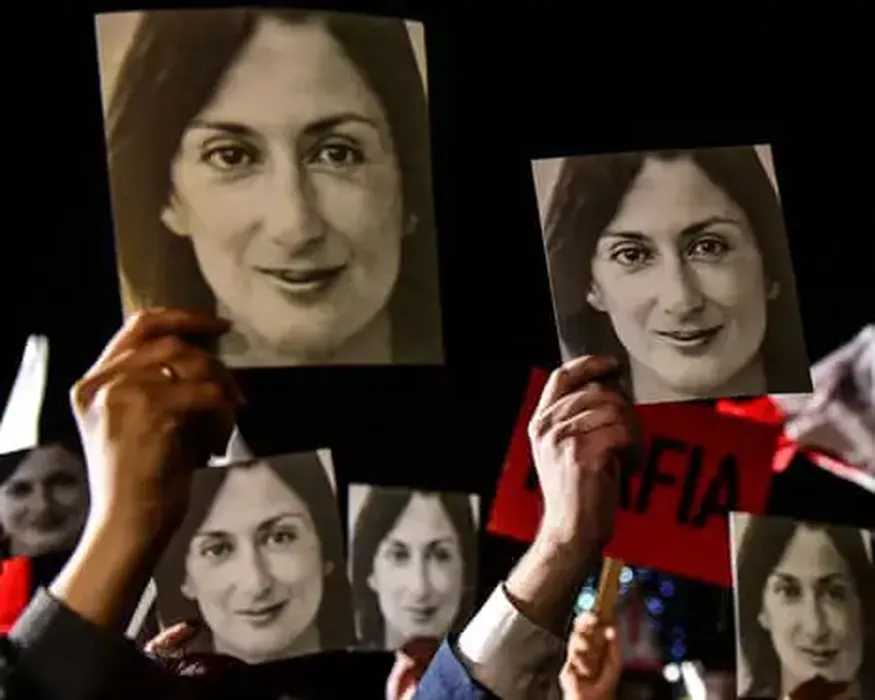
Nine years ago, Daphne Caruana Galizia, Malta’s foremost investigative journalist, was assassinated by a car bomb outside her home. The men who carried out the killing have been convicted or admitted their involvement. Nobody has been convicted of commissioning her murder.
Last week, a jury acquitted Yorgen Fenech, one of Malta’s most prominent businessmen, of complicity in the assassination and criminal association.
We have followed this case from different places: one of us from Malta, as a journalist and civil society activist campaigning for accountability after Daphne’s assassination; the other served as the Council of Europe’s rapporteur scrutinising the investigation and Malta’s failures of the rule of law.
We were shocked by the verdict, but we respect it.
The jurors decided, by eight votes to one, that Fenech’s guilt had not been proved beyond reasonable doubt. We are not asking for their verdict to be disregarded or reversed by political pressure.
But the verdict does not erase what the trial exposed.
Fenech admitted that he knew of the murder plan before Daphne was killed and that, while the plan was still live, he gave €50,000 to Melvin Theuma, the middleman who recruited the killers. Fenech said the money was intended to reimburse Theuma for money already paid and to persuade him to stop the assassination. He also admitted he passed confidential information about the police investigation to Theuma and gave him further sums of money. He told the court he was blackmailed by Theuma.
But Fenech denied commissioning or financing the murder. His explanation was that he had been acting out of misplaced loyalty to Keith Schembri, then chief of staff to Malta’s prime minister and one of his closest friends.
The picture is appalling. A businessman at the heart of Malta’s economic establishment, the prime minister’s closest aide and the man organising the murder of the country’s most prominent investigative journalist were moving within the same small circle.
Daphne had spent the last years of her life investigating precisely this proximity between political power, private wealth and people willing to operate outside the law.
The Maltese government itself commissioned an independent public inquiry into her assassination. It concluded in 2021 that the state had created a culture of impunity and an atmosphere in which her murder became possible. Five years later, most of its recommendations remain unimplemented. Nor has there been anything approaching adequate accountability for the corruption Daphne was investigating.
There are uncomfortable precedents. In Russia, people were convicted for their roles in the murders of journalist Anna Politkovskaya and opposition politician Boris Nemtsov. But the European court of human rights found that the authorities had failed adequately to identify and pursue those who actually commissioned the killings.
Malta is not Russia, but it is the case that convicting the people who carried out a murder cannot be the end of the state’s responsibility if whoever commissioned the crime remains unidentified and unpunished. This should concern Brussels as much as Valletta.
Malta’s failures do not stop at its coastline. A licence to conduct business in Malta, with limited government supervision, is effectively a licence to conduct business across the European Union. Weak enforcement in one member state creates opportunities throughout the union.
This is why impunity in Malta is not merely a Maltese problem.
On Wednesday, the parliamentary assembly of the Council of Europe (Pace) returned formally to Daphne’s case. Its committee on legal affairs and human rights heard evidence from Daphne’s son Matthew Caruana Galizia and her sister Corinne Vella. Shami Chakrabarti, the committee’s rapporteur, is preparing a new report, entitled Justice delayed: the unfinished implementation of the Daphne Caruana Galizia case. Her mandate includes examining the implementation of the public inquiry’s recommendations and Malta’s compliance with Council of Europe standards on the rule of law and press freedom.
The timing could hardly be more important. Even Pace’s own monitoring committee, while recognising reforms undertaken since 2019, concluded that they addressed only part of the deficiencies and that comprehensive reform of Malta’s democratic institutions and system of checks and balances remained necessary.
Malta’s prime minister, Robert Abela, should meet Chakrabarti at the earliest opportunity and give her work the Maltese government’s full cooperation. But the Council of Europe should go further.
Pace has a monitoring committee specifically charged with examining whether member states are meeting their obligations to democracy, human rights and the rule of law. Malta has already been examined by that committee, which raised concerns about corruption, checks and balances, parliamentary oversight and the continuing culture of impunity. The events of the past week strengthen the case for renewed, comprehensive scrutiny of the state of the rule of law in Malta.
Europe owes something to Daphne and to her family, who have spent nearly nine years fighting for truths the state should have established without requiring their persistence. But there is also a matter of European self-interest. The EU and the Council of Europe cannot afford pockets within their borders where serious corruption goes unpunished and political and economic power can frustrate accountability.
The jury has decided that the prosecution did not prove Yorgen Fenech criminally responsible for Daphne Caruana Galizia’s murder. That judgment must be respected. It cannot become an answer to everything else.
Nearly nine years after Daphne was assassinated, nobody has been convicted of ordering her murder. Much of the corruption she exposed remains unpunished. Most of the reforms recommended by the public inquiry remain undone. It is high time for Europe to start paying attention again.
Pieter Omtzigt is a former Dutch MP who served as the Council of Europe parliamentary assembly’s rapporteur on the assassination of Daphne Caruana Galizia and the rule of law in Malta. Emanuel Delia is a Maltese journalist and co-founder of Repubblika, a civil society organisation campaigning for rule of law and accountability in Malta