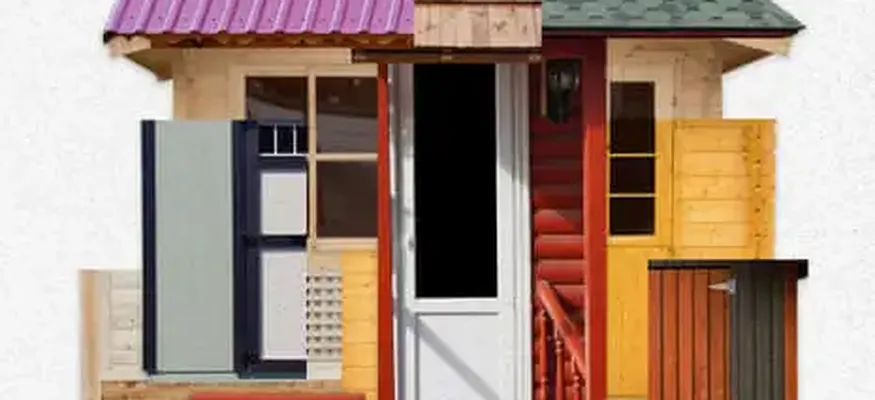
Linda loves her shed. She loves that she can work there rather than in her dining room, which her toddler likes to tear through. She loves its Scandinavian vibe – it’s clad in wood and set on decking at the bottom of her garden. She loves the views of the countryside from the window by her desk. Or she did. Her desk faces the wall now, because she’s too nervous to face her neighbour. She never sits on the decking, either. “What if they see me?” she says. “It’s a horrible feeling.”
Linda’s neighbours are unhappy about her shed, or “garden room”, which is actually two rooms. They do not like its size (7.25 metres by 2.74 metres, or 3.5 metres if you include the raised decking) or its position, about 30 metres away from their house. Linda says they have barely spoken since the construction, which is awkward, as the gardens are separated by a low fence.
The neighbours say the shed is more than half a metre too tall and too close to their property for it to be a “permitted development”, one that can be built without applying for planning permission. In England and Wales, there is a height cap of 2.5 metres from the ground if any part of the outbuilding falls within 2 metres of a boundary (it is within 1 metre of a boundary in Scotland). If the building is further from the boundary, it can be 3 metres or 4 metres high, depending on the roof type. The council agreed and told Linda she needed to apply for retrospective planning permission. She says it was an “honest mistake” and that she received the wrong guidance from her builders. “I was mortified. I would never have done it intentionally,” she says.
Before the build, Linda says, she had a friendly relationship with her neighbours; they would lend each other tools and garden materials. She says she had had an informal conversation with her neighbours about building a garden room in the space and heard no objections. Her neighbours say they were not consulted at all before construction, which took about a month.
Linda says she found out the extent of her neighbours’ feelings about her shed only in the paperwork for their planning dispute. They said they could see it from every window of their home and that they felt they had lost all sense of privacy, which had affected their daily lives and mental wellbeing. They also said an estate agent told them it had negatively affected the value of their home.
Retrospective planning permission for her shed has been granted, on the condition that a privacy screen and other planting are put up. Was it worth it? Yes, Linda believes, but she says: “I wish we had known to go about it the right way; it would have saved us money and a heck of a lot of effort and time …”
The dispute between Linda and her neighbours is just one example of simmering resentment over the increased use of these kinds of outhouses in the UK. The news is regularly peppered with spicy shed disputes – and no social strata is exempt. Pink Floyd’s David Gilmour was ordered to move a shed in his garden in upmarket Hampstead, north London, last year after it was described as “intrusive” and “overbearing” by neighbours who wanted a retrospective planning application to be refused. It was ordered to be rebuilt further back from the boundary.
Part of the reason for these disputes is the growing popularity of outhouses. Simon Rix, a senior planning consultant and a director of Planix.uk, a consultancy company that advises people who want to extend, says he received “a trickle” of clients who wanted to build luxury sheds before the pandemic, but that has “probably gone up tenfold”.
As well as home offices, gyms and storage, many are used for habitable living spaces, as the housing crisis continues to stunt home-buying. “Quite a lot of people are coming to me because they want to move into it and let their children live in the main house,” Rix says. He is also seeing more static caravans in gardens for the same reason – these don’t count as a “development” and do not need planning permission if they are housing a family member. “Neighbours get really grumpy, because they can be quite tall and imposing,” he says.
Planning rules around these outhouses are “monumentally complex”, says Rix, who would like them to be simplified. Both sides regularly misunderstand their rights. “Neighbours frequently assume that if something looks large, blocks a view or sits right on the fence line, it must be illegal. Conversely, homeowners often wrongly assume: ‘It’s my garden, I can do what I want.’ This gap in understanding, combined with the post-pandemic boom, is creating a perfect storm for neighbourhood disputes,” he says.
The regulations and rules around erecting outbuildings as part of permitted development vary not only in terms of the height and the proximity to a neighbour’s boundary. They must also be single storey and, in England and Wales, not “forward of the principal elevation” – the front wall of the house facing the highway (in Scotland, there is some provision for a small shed). Outbuildings cannot take up more than 50% of the total garden, either, and listed homes and those in conservation areas and other special sites face different restrictions. According to research by Ronseal, more than 40% of Britons are unaware some sheds will require a planning application.
double quotation markIt’s so close to the boundary, he climbed on to our picnic table with a tape measure
Yet even outhouses that meet permitted development heights can loom large and cause tension in tightly packed British gardens. Emma watched her husband creep into their garden under cover of darkness late one night to measure the shed their neighbours were constructing close to the boundary, because it looked so vast. “He climbed on to our picnic table with a tape measure,” she says. “It’s so close to our boundary that it wasn’t a stretch to measure it – he didn’t even need to hang over the fence.”
The shed measured under 2.5 metres and the couple had to accept that it was permitted. They felt that mentioning anything to the neighbour would only cause bad feeling, but while they have grown used to the building, which is barely used, they worry about how potential buyers will view it. “The overriding factor is they are small gardens,” says Emma. The plots are around 10 metres by 7 metres. The neighbour mentioned their plans, but “we thought it would be a pod … we didn’t anticipate the sheer size”, she says. “Remaining friends” was most important. “We get on well and didn’t want to rock the boat,” she adds. “But if it was being used as a home office constantly, with phone calls being made and they’re looking back at you, maybe we’d feel differently.”
Dr Mike Talbot, a psychotherapist and the CEO of UK Mediation, says the company has noticed a rise in inquiries concerning external structures such as sheds, garden rooms, hot tubs and even trampolines. He believes that councils tend not to intervene and often recommend mediation. Fewer than 10% of inquiries actually reach that stage, though, because while the opposing neighbour is usually the one to call them, they must then approach the shed builder – who generally does not wish to join (or share the £450 cost of the process). He recalls an occasion when a shed window “was mysteriously broken” and things turned nasty: “The shed owner went round and threatened to smash their neighbour’s face in.”
However, if mediation takes place, it can be positive. One set of neighbours built a shed to be used as a playroom and office with a window on the neighbour’s side. They had previously had a good relationship, but were “not talking … which is quite common”. (Talbot says “slamming doors or dirty looks in the driveway” are other repercussions.) The compromise was blocking the window and putting up a trellis, which appeased both parties. In another example, an agreement was made concerning the times at which the shed owner’s teenage children could use the space.
Talbot believes that people are “more insular” than they used to be and less concerned than previous generations were about getting on with their neighbours. Social media plays a part, too. “We are so much more subject to scrutiny and you know that, if you do something people consider to be out of order, it’s going to be on the local Facebook group,” he says. “Trust is slower to build; we are more cautious of whom we talk to.” But if neighbours build a good relationship, he says, they are less likely to react negatively if a large shed does appear.
Dan has a good relationship with his neighbours, so when they approached him to discuss their plans for a structure in their 20-metre garden for a family member to stay in, “I had no problem”, he says. As it would be more than 2.5 metres high and a habitable dwelling, the neighbours had to apply for planning permission. “I looked at the plans and it seemed reasonable,” says Dan.
However, issues encountered during construction meant the height increased. When Dan and his partner arrived home from holiday, “I went to our bathroom, looked out of the window and said: ‘You need to come here immediately and look at this monstrosity,’” he says. After an emotional conversation with the neighbours, they agreed to take the height down, but Dan believes it is still about 1.5 metres higher than agreed in the original plans. For the sake of keeping good relations, he has decided not to go to the council and has instead spent about £2,000 on fencing to try to hide the structure.
“I did not want to ruin their plans,” he says. “But I did feel emotionally blackmailed.” While he is getting used to it, and continues to chat pleasantly with the neighbours, “when we look out of our living room window, it’s right there. And if someone is stood in that building, they are looking right in at us. It just feels slightly invasive. When people come round and notice it, they go: ‘Oh my God, what?’ They’re shocked.” Dan’s main worry, however, is the impact it may have when he comes to sell his house.
Linda, meanwhile, hopes to rebuild relations with her neighbours. “We’re not horrible people, on either side,” she says. “No one has done anything wrong here.” But unlike her shed, which will weather and soften, she knows there is no guarantee of this.
Names have been changed
Do you have an opinion on the issues raised in this article? If you would like to submit a response of up to 300 words by email to be considered for publication in our letters section, please click here